

This Sunday’s Readings
First Reading: Ezekiel 34:11–12, 15–17: I myself will pasture my sheep; I will judge between sheep and sheep.
Psalm: Psalm 22(23):1–3a, 5–6: The Lord is my shepherd; there is nothing I shall want.
Second Reading: 1 Corinthians 15:20–26, 28: Christ must reign until every enemy, death last of all, is put under His feet, so that God may be all in all.
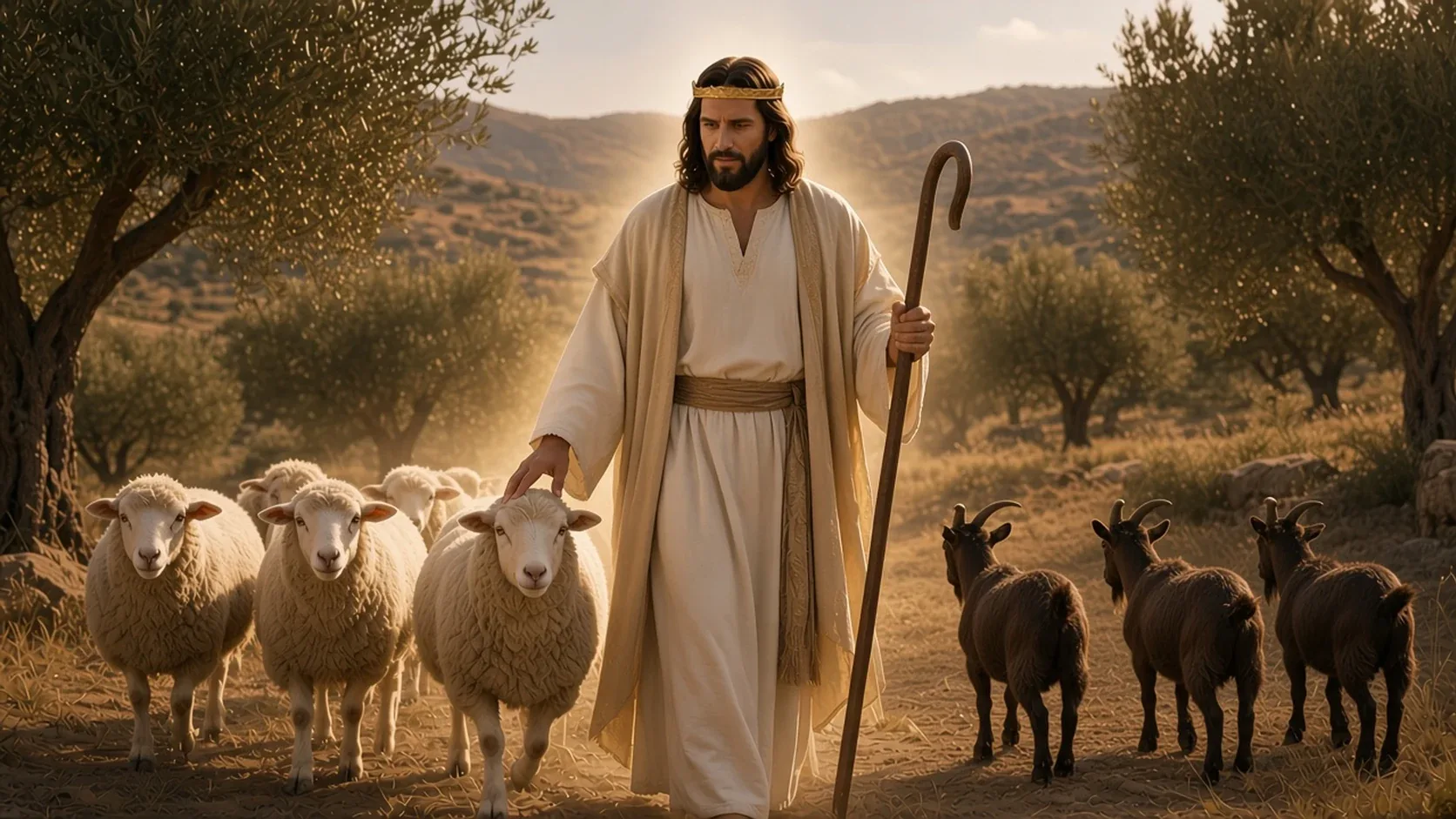
Gospel: Matthew 25:31–46: The King separates the nations as a shepherd separates sheep from goats.
This Week’s Gospel
“None are more hopelessly enslaved than those who falsely believe they are free.” Those words were written by Johann Wolfgang von Goethe more than two hundred years ago, and they have never been more true. We think of ourselves as free. We choose what we buy, what we watch, how we live. Yet the Church’s prayer for this feast asks God for something surprising: that the whole creation would be “set free from slavery”. On this last Sunday of the Church’s year we celebrate a King who comes to set slaves free. But if we want to understand how He frees us, we first have to see how we are enslaved, even when we think we are free.
Scripture speaks of two kingdoms, the kingdom of darkness and the kingdom of Christ. Saint Paul says that God “has taken us out of the power of darkness” and brought us into the kingdom of His Son. So our real struggle is not with other people. Our enemy is the devil and the fallen angels with him. He sets us against one another, and he enslaves us above all through lies. Jesus calls him “a liar, and the father of lies.” The devil cannot force anyone into his kingdom. He can only persuade. He gets us to believe something false, and once we believe it, we start to live by it. Each lie we accept opens a door and gives him a hold on us.
And the devil’s lies are not always easy to spot, because he rarely tells them openly. In the garden he did not offer Eve something ugly. He hid the lie inside something good, fruit that was lovely to look at. Saint Paul warns that “Satan himself goes disguised as an angel of light.” So the devil makes evil look like kindness or freedom. Ending the life of a child in the womb is called a woman’s freedom to choose. Helping the sick or the elderly to die is called compassion. Pornography is sold as harmless private freedom, while it quietly trains the heart to use people rather than love them.
The deepest of those lies is that the way things are is the way things are meant to be. We live in a fallen world, and we grow so used to sin that it starts to look normal. Greed begins to seem sensible, gossip is just harmless talk, and living together before marriage is simply what everyone does.
But sin is not who we are, and a world wounded by sin is not the world as God made it. What is real and lasting is the reign of Christ. All things were made for Him, and in Him God will restore them. We can already see what that reign looks like in Jesus Himself. He healed the sick, forgave sinners and welcomed them home, and brought good news to the poor. Where Christ reigns, people are not used or discarded. Each one is treated as what he truly is, a person made for God. That is not a dream laid over the real world. It is the real world.
The sins that every age calls normal will pass away with that age. Saint Paul warns that those who live by them will not inherit the kingdom of God. But whoever lives by the will of God will live with Him for ever. The kingdom of God will come in full, and every one of us will be judged: the good rewarded, the wicked punished.
This is God’s plan. At His first coming, Christ came as the suffering servant, bringing mercy. At His second coming, He will come in justice and in glory, and this Sunday’s Gospel shows us that day. When the Son of Man comes in His glory, He separates the nations as a shepherd separates sheep from goats. He says to those on His right, “take for your heritage the kingdom prepared for you since the foundation of the world.” He sends those on His left to “the eternal fire prepared for the devil and his angels.” The Kingdom was prepared for us. The fire, on the other hand, was prepared for the devil. God made no one for hell. Those who go there have refused the kingdom made for them and taken the devil’s side. And the separation is final: “they will go away to eternal punishment, and the virtuous to eternal life.”
How can a person take the devil’s side without knowing it? Well, notice in the Gospel both groups ask the King the same question: “Lord, when did we see you?” The difference lies in what they did. The virtuous simply fed the hungry and visited the sick. But the others, they turn the question into an excuse: if we had known it was You, of course we would have helped. The lie behind their excuse is that the hungry man, the stranger and the prisoner do not matter.
We end up on the wrong side because of excuses, and there are many of them: “Someone else will see to it.” “They brought it on themselves.” “I have enough troubles of my own.”
In A Christmas Carol, when Scrooge is asked to give something for the poor at Christmas, he asks, “Are there no prisons?” When he is told that many of the poor would rather die than go there, he answers, “It’s not my business.” Marley’s ghost reminds him of a fundamental truth that he had forgotten: “Mankind was my business.”
Scrooge measured the poor by what they would cost him. The world still measures people that way, by what they earn, what they can do and how useful they are. But Jesus says: “In so far as you did this to one of the least of these brothers of mine, you did it to me.” When the Son of God became man, He united Himself with every human being. So in a very real sense, the way we treat the least of His brothers and sisters is the way we treat Him.
A person’s worth is not found in their usefulness. A person’s worth is that God made them, loves them, and gave His Son for them. Through Christ in Baptism, you and I are beloved sons and daughters of the Most High. But the devil wants us to forget the extraordinary dignity God has given us, and so he plants his lies where we are most tender. When we are hurt or afraid, we make quiet decisions to protect ourselves: I can trust no one; I have to look after myself; I will never be good enough. We begin to live by them. “I can trust no one” makes us cold and closed. “I have to look after myself” makes us selfish. “I will never be good enough” leaves us bitter or quick to give up. Over time those habits feel so familiar that we think they are simply part of who we are: “That’s just me. I’ve always been like that.” The more we have lost sight of our own dignity, the less we can see it in others as well.
Jesus said, “I am the Truth,” and He promised, “the truth will make you free.” The truth that frees us is not an idea. It is a Person.
The more we know Christ, the more clearly we see who we really are, and who our neighbour really is. Then the lies we have believed about ourselves and others are exposed for what they are, and they lose their grip.
So name the lie. Turn away from it. Hold on to Christ. Every time we do, we shut a door we had opened to the devil, and we live again as citizens of His Kingdom.
This King rules by serving. He “came not to be served but to serve”, and He served us to the point of death, giving His life so that our sins could be forgiven and we could go free. Whoever belongs to His kingdom must take the same way, the way of the cross. There is a kind of Christianity that wants the King without the cross, a Jesus who asks nothing of us. It is a comfortable lie.
The true King asks everything of us, because He gave everything for us.
Christ is our King, and so we pray: Heavenly Father, You have taken us out of the power of darkness; keep us in the kingdom of the Son You love. Free us from every lie, and lead us into Your Kingdom by serving You in our brothers and sisters. On the last day let us hear Your Son say, “Come, you whom my Father has blessed.” Amen.
How the Readings Fit Together
Long before the Gospel, God promised through the prophet Ezekiel that He would shepherd His people Himself: “I shall look for the lost one, bring back the stray, bandage the wounded and make the weak strong.” Yet the same passage ends with judgement: “I will judge between sheep and sheep, between rams and he-goats.” The Shepherd who searches and the Judge who separates are the same Lord. Jesus fulfils both halves of that promise. At His first coming He went looking for the lost; when He comes in glory, He will separate the sheep from the goats. The mercy of the first coming and the justice of the second come from one heart.
Saint Paul shows where the reign of Christ is heading. Christ has been raised from the dead, “the first-fruits of all who have fallen asleep”, and “he must be king until he has put all his enemies under his feet”. The last enemy to be destroyed is death itself. By His Resurrection Christ has already overcome the kingdom of darkness, and at the end He will destroy every power that opposes Him. That is why the lies of every age cannot last: they belong to a kingdom that has already lost. Everything will be placed under Christ, “so that God may be all in all.” To live in His Kingdom now is to live by what will remain for ever.
A Word from the Saints
Saint Teresa of Calcutta spent her life serving the poorest people of Calcutta, because she took this Gospel at its word: Christ is truly present in the least of His brothers and sisters. In her lecture on receiving the Nobel Peace Prize, she explained that the Son of God became man so that we could love as He loves us, and that He hides Himself in the very people the world passes by:
“He makes himself the hungry one – the naked one – the homeless one – the sick one – the one in prison – the lonely one – the unwanted one – and he says: You did it to me.”
— Saint Teresa of Calcutta, Nobel Lecture, 11 December 1979
A Question for Reflection
Which excuse do I reach for most often when someone needs me, and what lie about that person is hidden inside it?
Next Sunday
First Sunday of Advent, Year B — 29 November 2026
Isaiah 63:16–17, 64:1, 3–8; Psalm 79(80):2–3, 15–16, 18–19; 1 Corinthians 1:3–9; Mark 13:33–37.
A new Church year begins. Jesus tells His disciples to stay awake, because they do not know when the master of the house is coming: “And what I say to you I say to all: Stay awake!”