

This Sunday's Readings
First Reading: Isaiah 5:1-7: The vineyard of the Lord of hosts is the House of Israel
Psalm: Psalm 79:9, 12-16, 19-20: The vineyard of the Lord is the House of Israel
Second Reading: Philippians 4:6-9: The God of peace will be with you
Gospel: Matthew 21:33-43: He will lease the vineyard to other tenants
This Week's Gospel
This Week’s Gospel
The first sentence of Jesus’ parable is meant to sound familiar. A landowner prepares a vineyard completely, planting it and providing a boundary, a press and a watchtower. Everyone listening would recognise the vineyard from Isaiah’s song in the first reading. But Jesus changes the story. The problem is no longer sour grapes. It is tenants who refuse to hand over the fruit.
The owner has done everything needed to make the vineyard flourish. He entrusts it to tenants and leaves. At harvest he sends servants to receive what is due, but the tenants answer with assault and murder. A larger company of servants receives the same treatment. At last the owner sends his son: “They will respect my son.”
The tenants recognise the heir and decide that killing him will let them seize the inheritance. They carry out the plot, expelling the son from the vineyard and murdering him. They have forgotten the one word that tells the truth about them: tenants. The vineyard has been placed in their hands, but it has never become their possession. They want the inheritance without the heir, a gift they can seize while rejecting the one through whom it comes.
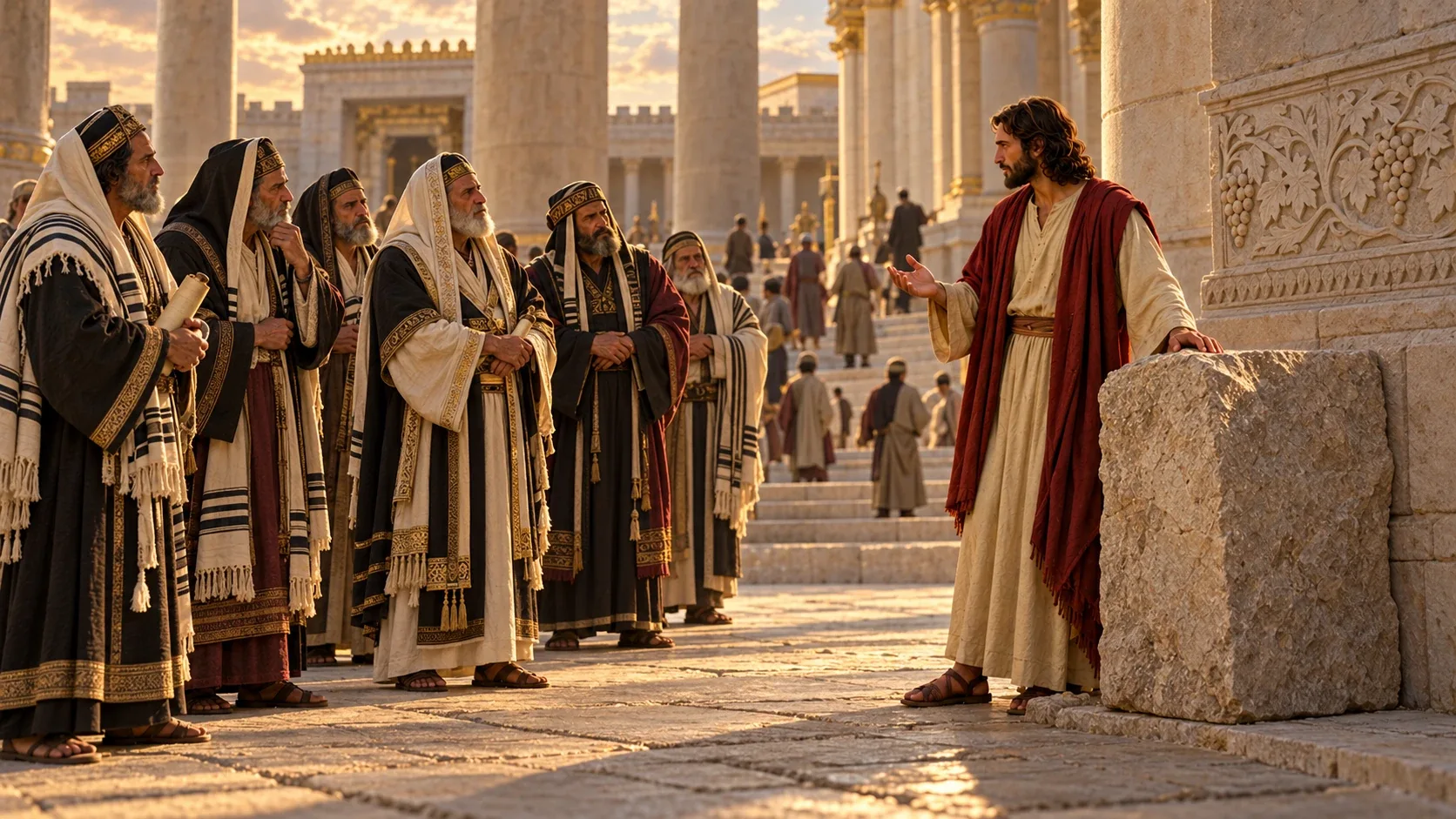
Jesus asks the chief priests and elders what the owner will do. Their answer passes judgment on the tenants — and, without their yet realising it, on themselves. But Jesus does not allow the story to end with violence and destruction. Turning to Psalm 118, he identifies the rejected stone as the keystone established by God. The Son cast out of the vineyard is not defeated. In the Resurrection, the Father makes the rejected Christ the foundation of a people who will produce the fruit of the Kingdom.
How the Readings Fit Together
Isaiah sings a love song for his friend's vineyard, planted with choice vines on a fertile hillside, with a tower built in the middle and a press dug beside it. Sour grapes were all it gave. Then God asks in His own voice, "What could I have done for my vineyard that I have not done?" He had spared nothing for its cultivation and its beauty. The last line names the vineyard as the House of Israel: "He expected justice, but found bloodshed, integrity, but only a cry of distress." In Hebrew the pairs sound almost alike. He looked for mishpat and found mispach; He looked for tsedaqah and heard tse'aqah. What He found was the opposite of what He planted.
Jesus opens His parable with Isaiah's own details, the fence, the winepress and the tower. The vineyard is the same one. The story moves in a new direction, though. In Isaiah the fault lies in the vineyard itself, and it is laid waste. In the Gospel the fault lies with the tenants, and the vineyard is kept. The owner holds on to what he planted and hands it to others who will deliver the produce.
The servants are God's prophets. They came with a message of repentance, calling the people to amend their lives, to give up whatever was sinful and to devote themselves to God. The people would not listen. They rejected the prophets and killed some of them. Still the Master kept sending His messengers. God in His great love never ceases to send messengers calling us back to Himself.
The psalmist looks at the vine God brought out of Egypt, its walls broken down and ravaged by the boar of the forest, and prays: "God of hosts, turn again, we implore, look down from heaven and see. Visit this vine and protect it, the vine your right hand has planted." God answered that prayer beyond anything the psalmist asked. He visited His vine by sending His own Son. Many did not listen to Him, even after witnessing the wonders and miracles He worked. Yet the stone rejected by the builders has become the keystone. The One they rejected and crucified, the Father raised from the dead, and within weeks St Peter stood before the same council and applied that verse to the risen Christ (Acts 4:11).
God has not stopped sending messengers. Jesus has sent the Holy Spirit among us, and the same Spirit who makes us holy strengthens us with His gifts to bear witness to Christ. The Second Vatican Council teaches that the confirmed are obliged to spread and defend the faith, by word and by deed, as true witnesses of Christ (Lumen Gentium 11). Priests and religious carry that responsibility, and so does every Christian.
Yet most of us would rather not speak about Jesus. It makes people uncomfortable, and religion is supposed to be a private matter. Faith cannot be compartmentalised, though. It cannot be something expressed only within the walls of a church. We might not be killed as the prophets were, but we may lose people's respect, and some may think us a little strange. St Catherine of Siena, writing to a prelate of her own day, put it bluntly: "Alas, be silent no more! Cry out with a hundred thousand tongues. I see that through silence the world is ruined."
The saints were always considered strange by the standards of their time, because they were more concerned with doing the will of God than with fitting in. They were happy to stand out if by doing so they could witness to Christ.
St Paul knew the cost of boldly proclaiming the Gospel.
He wrote to the Philippians from prison, in chains for preaching Christ, and he tells them that his chains have made most of the brothers bolder to speak the word without fear (Philippians 1:12-14). The Philippians had opponents of their own, and he urges them not to be intimidated by them in any way (1:28). Near the end of the same letter, in today's reading, he writes: "There is no need to worry; but if there is anything you need, pray for it, asking God for it with prayer and thanksgiving, and that peace of God, which is so much greater than we can understand, will guard your hearts and your thoughts, in Christ Jesus."
When Paul first preached in Philippi, the magistrates had him and Silas stripped and flogged in public. The jailer threw them into the inner prison and fastened their feet in the stocks. About midnight they were praying and singing God's praises, and the other prisoners were listening. That is exactly what Paul asks of the Philippians in today's reading: prayer and thanksgiving in place of worry. That same night the jailer and his whole household were baptised (Acts 16:22-34). They were among the first Christians in Philippi. The Philippians saw Paul's struggle when he was with them, and they now hear that he is still in it (1:30). He tells them that suffering for Christ has been granted to them as a privilege, as well as believing in Him (1:29). Paul is in chains again, and he asks them to follow his example: "Keep doing all the things that you learnt from me and have been taught by me and have heard or seen that I do."
Paul's chains made his preaching credible. He was not asking us to go anywhere he had not already gone, and the peace he promises in that passage comes from a man with every earthly reason to be anxious. So when Paul tells us, "There is no need to worry," we should not hear it as the advice of a man who has never had a care in the world. It is the testimony of a man who found, in a prison cell, a peace the world could neither give nor take away. And he tells us that same peace is ours, if we bring everything to God in prayer.
A Word from the Saints
St Paul Miki, a Japanese Jesuit, was crucified with twenty-five companions on a hill at Nagasaki on 5 February 1597. From his cross he preached to the crowd that had gathered for the execution, and he ended with a prayer that his death would bear fruit:
The only reason for my being killed is that I have taught the doctrine of Christ. I certainly did teach the doctrine of Christ. I thank God it is for this reason I die... After Christ's example I forgive my persecutors. I do not hate them. I ask God to have pity on all, and I hope my blood will fall on my fellow men as a fruitful rain.
(From a contemporary account of his martyrdom: Office of Readings, 6 February)
A Question for Reflection
Where have we kept silent about Christ for fear of losing someone's good opinion, and what would it take to speak of Him this week, by our words as well as our deeds?
Next Sunday
Twenty-Eighth Sunday in Ordinary Time, Year A: 11 October 2026
Isaiah 25:6-10; Psalm 22; Philippians 4:12-14, 19-20; Matthew 22:1-14.
"Invite everyone you can find to the wedding."