This Sunday’s Readings
First Reading: Jeremiah 20:7–9 — A fire burning in my heart
Psalm: Psalm 63:2, 3–4, 5–6, 8–9 — My soul is thirsting for you, O Lord my God
Second Reading: Romans 12:1–2 — Offer your living bodies as a holy sacrifice
Gospel: Matthew 16:21–27 — Take up your cross and follow me
This Week’s Gospel
Last Sunday Peter confessed, “You are the Christ, the Son of the living God,” and Jesus named him the Rock. Five verses later the same man takes Jesus aside and tries to talk Him out of the Cross.
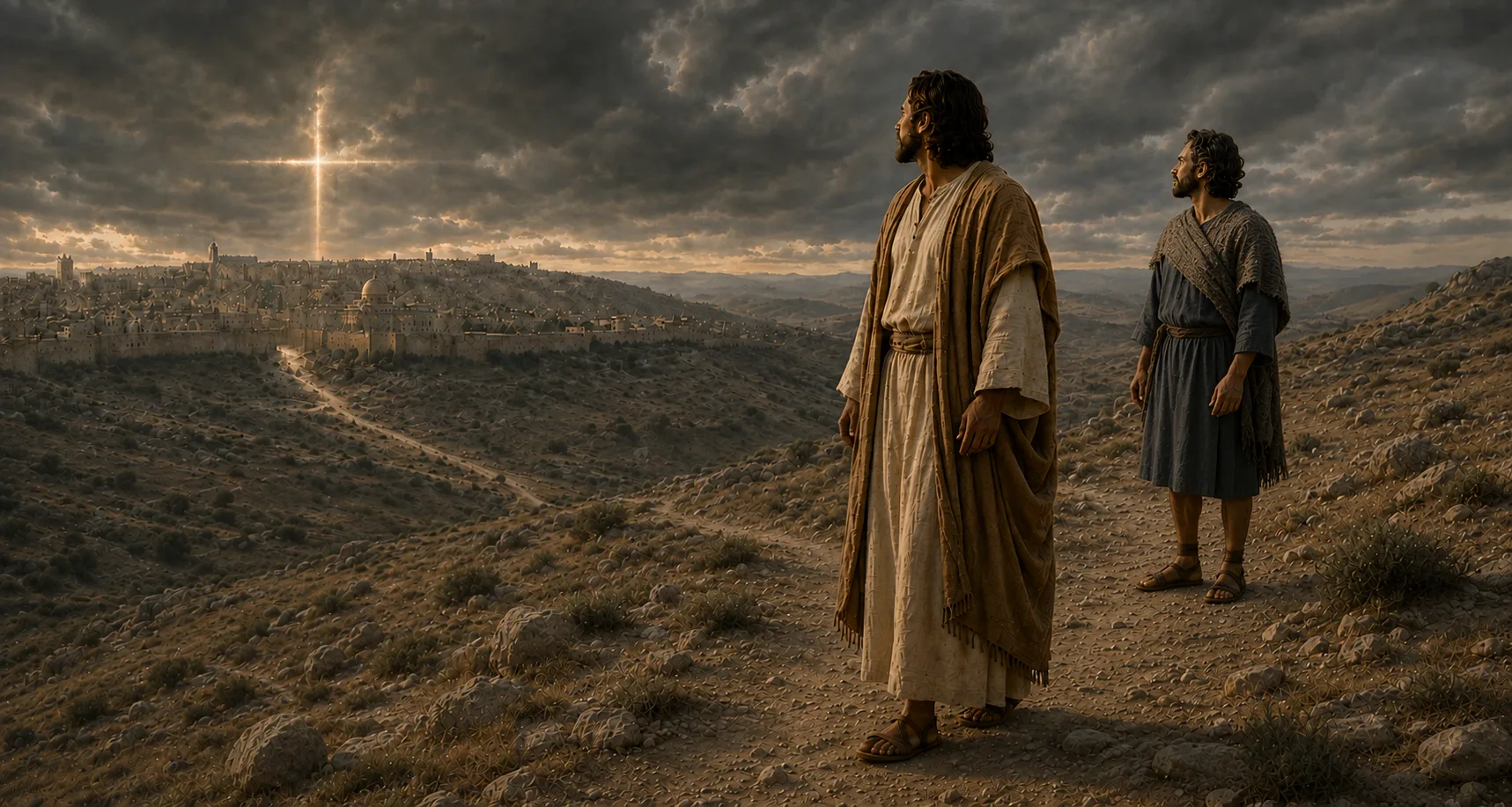
Jesus has begun to make it clear to His disciples that He is destined to go to Jerusalem and suffer grievously at the hands of the elders, chief priests and scribes, to be put to death and to be raised up on the third day. Peter remonstrates with Him: “Heaven preserve you, Lord; this must not happen to you.”
Jesus turns and answers with a severity that still startles: “Get behind me, Satan! You are an obstacle in my path, because the way you think is not God’s way but man’s.” Then He speaks to all of them. If anyone wants to be a follower of His, let him renounce himself and take up his cross and follow Him. Anyone who wants to save his life will lose it; anyone who loses his life for His sake will find it. What will a man gain if he wins the whole world and ruins his life?
The name is new. The man is not. Fulton Sheen saw the whole of Peter’s life in those two names. Simon is the fisherman’s own name, and it marks his natural instability: a man capable of great promises and of sudden fear. Peter is the name Christ gives him — the Rock, the vocation, the man grace will form. Christ does not call him Peter because Simon is already solid. He calls him Peter because, through Christ’s power, this shifting man will become the Rock on which He builds His Church. In today’s Gospel it is still the old man who speaks.
How the Readings Fit Together
Jeremiah has been overpowered by God and he knows it. Everything he has to say for the Lord wins him insult, so he decides he will not think of him or speak in His name again. He cannot keep the resolution. There is a fire in his heart, shut up in his bones, and holding it in wears him out.
Think of God’s mercy, Paul says, and then offer your living bodies as a holy sacrifice. Do not model yourselves on the world around you. Let your behaviour change, modelled by a new mind. We need that new mind if we are to see the crosses presented to us not as interruptions of the Christian life, but as the paths by which we die to self and help manifest the Kingdom of God.
The Gospel joins the two. Peter wants the glory without the Cross. Soft discipleship always does. It sounds merciful, because it promises to spare us the cost of conversion. But true mercy never discourages us from confronting the crosses which enable us to grow. If we are to be Christlike we must carry our cross too. A Christianity without the Cross leaves us exactly as we are. It may reassure; it cannot transform us. It cannot free us from the fears and appetites and old resentments that keep the soul restless and divided. The Christ we invent cannot save us, because he is not the living Christ.
That is why Jesus answers Peter so severely. He is not merely a comforter; He is to be our Crucified and Risen Lord. He has come not simply to make our present life easier, but to put the old life to death and raise us into His own. Then come the demands, and they are real demands. That is the shape of discipleship, not an optional extra for unusually heroic Christians. It is the price to make the Kingdom of God a reality among us.
The Christianity that demands less finally gives less. A life spent protecting itself from every costly demand of love becomes a cramped thing. A life surrendered to Christ becomes capable of fidelity, of forgiveness, of courage, of love.
Peter will learn this slowly. The man who tried to turn Christ away from the Cross will deny Him, and weep, and be forgiven, and receive the Holy Spirit, and follow his Lord in the end all the way. Sheen observes that the unstable man becomes the Rock through the power of his Divine Master. The grace that formed Peter is the grace that forms us: a mercy that does not flatter our old selves, and a discipleship strong enough to embrace the Cross, knowing that Christ will use it and transform it.
Christ does not offer us a soft Christianity, because He loves us too much to leave us unchanged. As His grace formed the unstable Simon and made him steadfast, so He forms us — through mercy, through conversion, through sacrifice, and through our share in His Cross and Resurrection.
The Fathers on Sunday’s Gospel
St John Chrysostom, preaching on this passage, notices that Jesus is not content with the rebuke of Peter. He goes on at once to show both how false Peter’s protest was and how necessary the Passion is — not only for Christ, but for anyone who would follow Him:
Thy word to me is, “This must not happen to you”: but my word to you is, “Not only is it hurtful to thee to hinder me and to be displeased at my Passion, but it will be impossible for you even to be saved, unless you yourself too are continually prepared for death.” He does not say, “You must suffer whether you will or not.” He says, “If any man will come after me.” I force no one. I compel no one. Each one I make lord of his own choice.
— Homily 55 on St Matthew
A Question for Reflection
Where does our following of Christ currently stop — the place where it begins to cost — and what would it mean, this week, to take one step further on that road?
Next Sunday
Twenty-Third Sunday in Ordinary Time, Year A — 6 September 2026
Ezekiel 33:7–9; Psalm 95; Romans 13:8–10; Matthew 18:15–20.
If your brother does something wrong, go and have it out with him alone. If he listens to you, you have won back your brother.