

Twentieth Sunday in Ordinary Time, Year A — 16 August 2026
This Sunday’s Readings
-
First Reading: Isaiah 56:1, 6–7 — A house of prayer for all nations
-
Psalm: Psalm 67:2–3, 5, 6, 8 — O God, let all the nations praise you!
-
Second Reading: Romans 11:13–15, 29–32 — The gifts and the call of God are irrevocable
-
Gospel: Matthew 15:21–28 — The Canaanite woman’s great faith
This Week’s Gospel
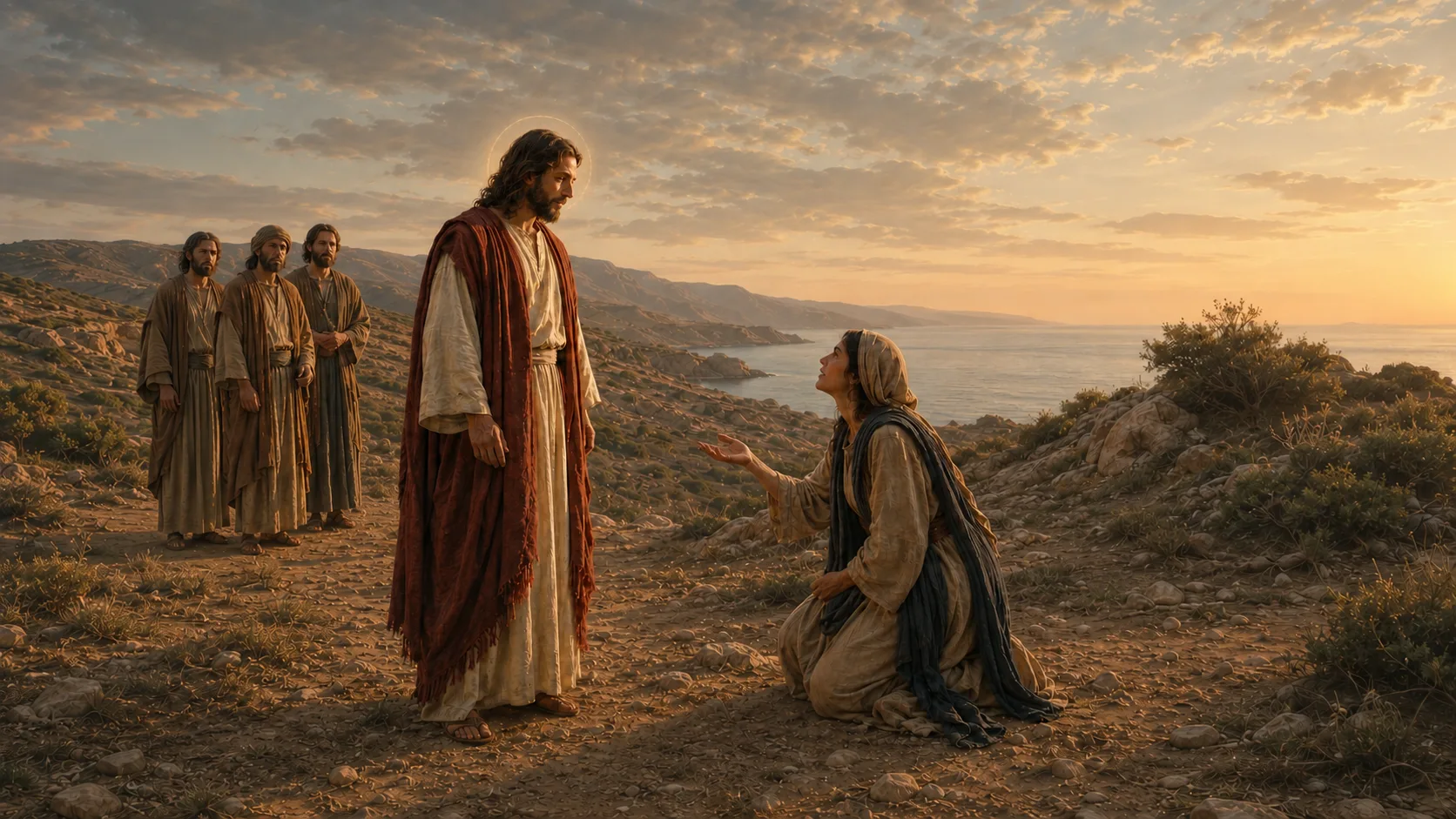
Jesus withdraws into the region of Tyre and Sidon. A Canaanite woman comes out to Him, calling Him “Son of David,” a title that already recognises His messianic identity, and begs for her daughter, who is tormented by a devil.
He initially does not answer her. The disciples, embarrassed by her persistence, ask Him to send her away. He tells them that He was sent only to the lost sheep of the House of Israel. Still she comes closer, kneels and says simply, “Lord, help me.”
He answers that it is not fair to take the children’s food and throw it to the house-dogs. She does not protest the ranking. She accepts it and turns it into a plea: even the house-dogs eat the scraps that fall from their master’s table.
At that moment Jesus praises her: “Woman, you have great faith. Let your wish be granted.” Her daughter is healed at once.
The whole encounter is a careful drawing-out of faith. Jesus’ silence, His restriction of the mission and even the hard comparison are not rejection. They are the means by which her humility and perseverance are brought into the open and publicly crowned. What begins as an outsider’s desperate cry ends as a model of the faith that receives everything.
How the Readings Fit Together
Isaiah sees a day when foreigners will join themselves to the Lord, love His name, keep His covenant and even minister before Him. The Temple itself will become “a house of prayer for all the nations.” What once seemed closed is thrown open.
Paul shows how that opening takes place. We, the wild olive branches, have been grafted onto the cultivated tree of Israel. Our inclusion is not a rejection of God’s people; it is part of the same plan. The gifts and the call of God are irrevocable, and mercy is the final word for both Jew and Gentile.
In the Gospel, the promise becomes flesh. The Canaanite woman has no claim on the covenant. She is a foreigner, a descendant of a people long held at a distance. Jesus’ silence and His hard words are not rejection. They are a test, an invitation for her faith to rise higher.
She does not demand a place at the table. She is content with the scraps. In that humility and persistence Jesus finds what He has been looking for: great faith. He grants her request and publicly honours her.
The testing of faith is not indifference. When God allows our faith to be tested, it is not because He has turned away. It is because He loves us. As we keep trusting Him through the difficulty, we come to know that love more deeply, because it is a love that has the power to carry us through anything. Such faith becomes a doorway through which God draws others to Himself.
We stand here only because that invitation has reached us. We are the foreigners who have been brought near. The Lord has called us into His household.
God still tests our faith, not to break it, but to deepen it. When prayer seems unanswered, or when we feel like outsiders even among the baptised, the Canaanite woman shows us the way: keep asking, keep trusting and remain humble.
The Master of the house is not mean with His gifts. He is waiting for the kind of faith that approaches without entitlement and without despair, with complete trust.
The Fathers on Sunday’s Gospel
St John Chrysostom, preaching on this passage, explains why the Lord did not immediately give the woman what she asked for:
“He delayed granting her request that He might reveal the woman’s perseverance and make her virtue manifest … that her faith might be displayed like a jewel held up to the light.”
(Homily 52 on St Matthew)
A Question for Reflection
When has our faith been tested recently? Did we respond with trust and humility, or with entitlement or despair?
Next Sunday
Twenty-first Sunday in Ordinary Time, Year A — 23 August 2026
-
Isaiah 22:19–23
-
Psalm 138
-
Romans 11:33–36
-
Matthew 16:13–20
At Caesarea Philippi, Jesus asks the disciples who they say He is. Peter answers, “You are the Christ, the Son of the living God.”