

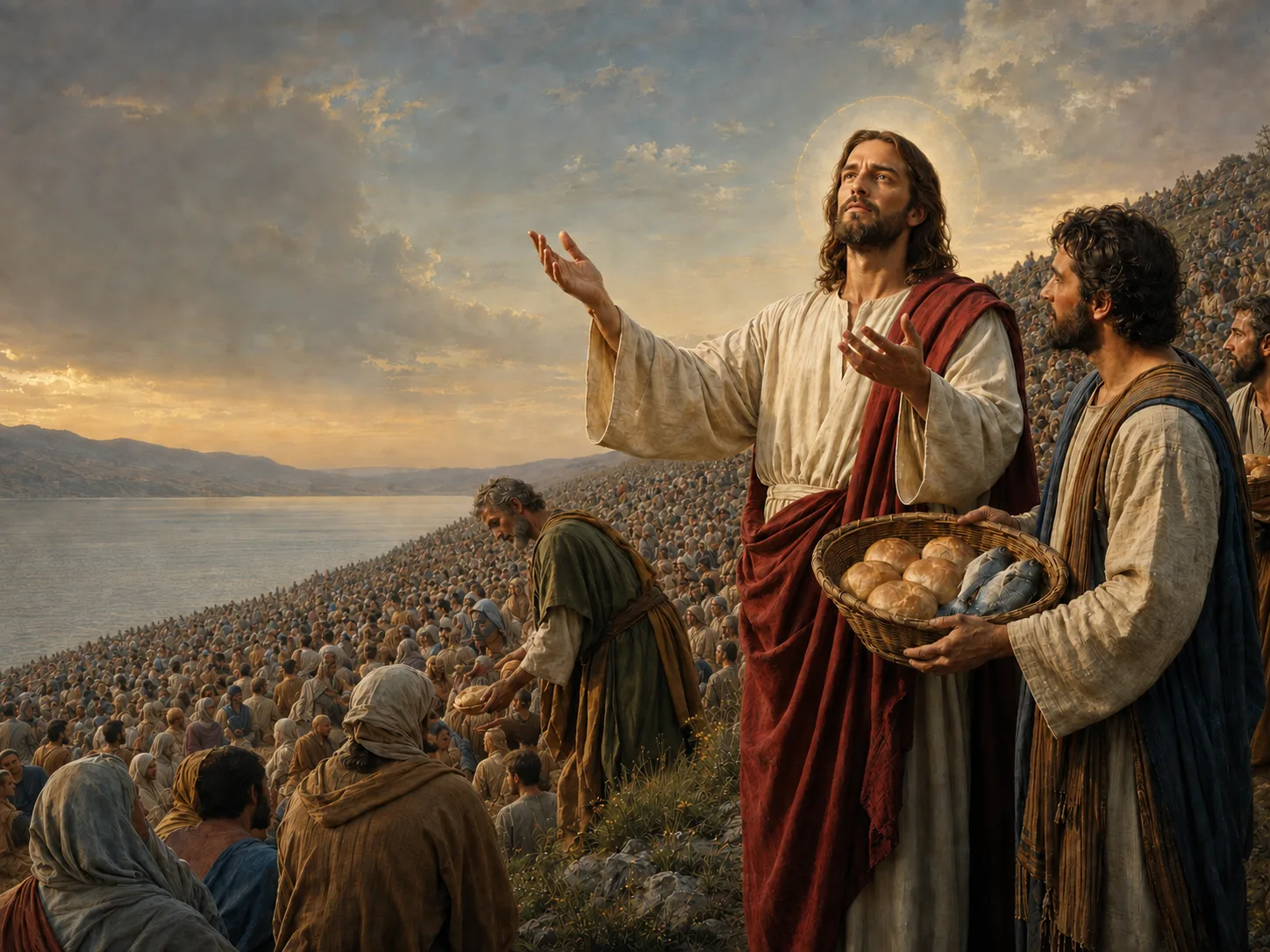
Eighteenth Sunday in Ordinary Time, Year A — 2 August 2026
"They all ate as much as they wanted, and they collected the scraps remaining; twelve baskets full."
This Sunday's Readings
First Reading: Isaiah 55:1-3 — Come and eat
Psalm: 144(145):8-9, 15-18 — The hand of the Lord feeds us; He answers all our needs
Second Reading: Romans 8:35, 37-39 — No created thing can ever come between us and the love of God made visible in Christ
Gospel: Matthew 14:13-21 — The feeding of the five thousand
This Week's Gospel
Jesus has just been told that John the Baptist is dead, and He withdraws by boat to a lonely place. The crowds work out where He is going and follow Him on foot from the towns, so that when He steps ashore they are already waiting. He takes pity on them and heals their sick. As evening comes on, the disciples ask Him to send the people away to buy food for themselves, and He tells them instead to feed the crowd. They have five loaves and two fish. He takes them, raises His eyes to heaven, says the blessing, breaks the loaves and hands them to the disciples, who carry them out to the people. Five thousand men eat as much as they want, besides women and children, and twelve baskets of scraps are gathered afterwards.
How These Readings Fit Together
Two details of the miracle are easily passed over. The first is that there was nothing to see. No loaves fell from the sky and none were seen to grow larger and larger. The multiplying happened in the breaking, in Christ's own hands, and not one person in that crowd witnessed the miracle performed. The second is that the loaves were multiplied miraculously and distributed perfectly normally. Christ did the impossible part Himself and then handed the bread to the Apostles, who walked it out to the people. Both details are the pattern of the Mass. Nothing miraculous is seen at the consecration, and what is given is carried to us through human hands.
Between those two facts stands the abundance. Nobody on that hillside was handed a portion and nobody went home half fed. When God sets out to satisfy people, He satisfies them to the full, and there were twelve baskets over.
Isaiah has been saying so for seven hundred years. He stands before God's own people instructing them that the Lord offers us everything but they are choosing to starve anyway. "Come to the water, all you who are thirsty, and though you have no money, come". Nothing is asked of them except that they be thirsty. Then he points out why they are not reaching for what truly satisfies: they are investing themselves in all the wrong things. He never says those things leave us empty, because they do not. They do fill us in a certain way, and that is the trouble with them. Junk food will fill a man without ever nourishing him, and the real damage it does is to his appetite, so that he can sit down to a good dinner and only push it round the plate. Our desires are formed the same way, by whatever we habitually feed them on, so that a week spent feeding the wrong ones leaves us with no hunger for Christ in the Blessed Sacrament.
Which leaves us with the question the Gospel puts to every practising Catholic. If we are truly receiving the Lord of heaven and earth at this altar, why do so few of us walk out of church looking like people who have been satisfied? St Thomas answers that the defect is never in the power of Christ, who gives Himself full and entire, exactly the same to every one of us. The difference lies in the devotion of the one receiving Him. Each of us carries away as much as we made room for.
The Fathers on Sunday's Gospel
St John Chrysostom, preaching on this passage in Antioch, takes up the two objections the disciples put to Our Lord that evening, that the place was a lonely one and that the hour was already gone, and answers them in turn:
"Although the place be desert, yet He that feeds the world is here; and although the time be now past, yet He that is not subject to time is discoursing with you."
Homily 49 on St Matthew
He notices too that Our Lord gave the bread out through the hands of the Twelve so that when the miracle was over they could not disbelieve it or forget it, since their own hands had borne witness to it, and that the baskets gathered up came to exactly the number of the Apostles, neither more nor less.
A Question for the Family Table
What did we spend last week on, in time and attention and energy? And did any of it leave us hungrier for God, or less hungry?
Next Sunday
Nineteenth Sunday in Ordinary Time, Year A — 9 August 2026
1 Kings 19:9, 11-13; Psalm 84(85); Romans 9:1-5; Matthew 14:22-33. The disciples are sent out onto the lake alone, Christ comes to them walking on the water in the fourth watch of the night, and Peter asks to be called out to Him.