

This Sunday's Readings
First Reading: 1 Kings 3:5, 7–12. "You have asked for a discerning judgement for yourself."
Responsorial Psalm: Psalm 118(119). ℟ Lord, how I love your law!
Second Reading: Romans 8:28–30. "He predestined us to become true images of his Son."
Gospel: Matthew 13:44–52. "He sells everything he owns and buys the field."
This Week's Gospel
We come to the end of the thirteenth chapter of Matthew, and to the last of the parables of the Kingdom.
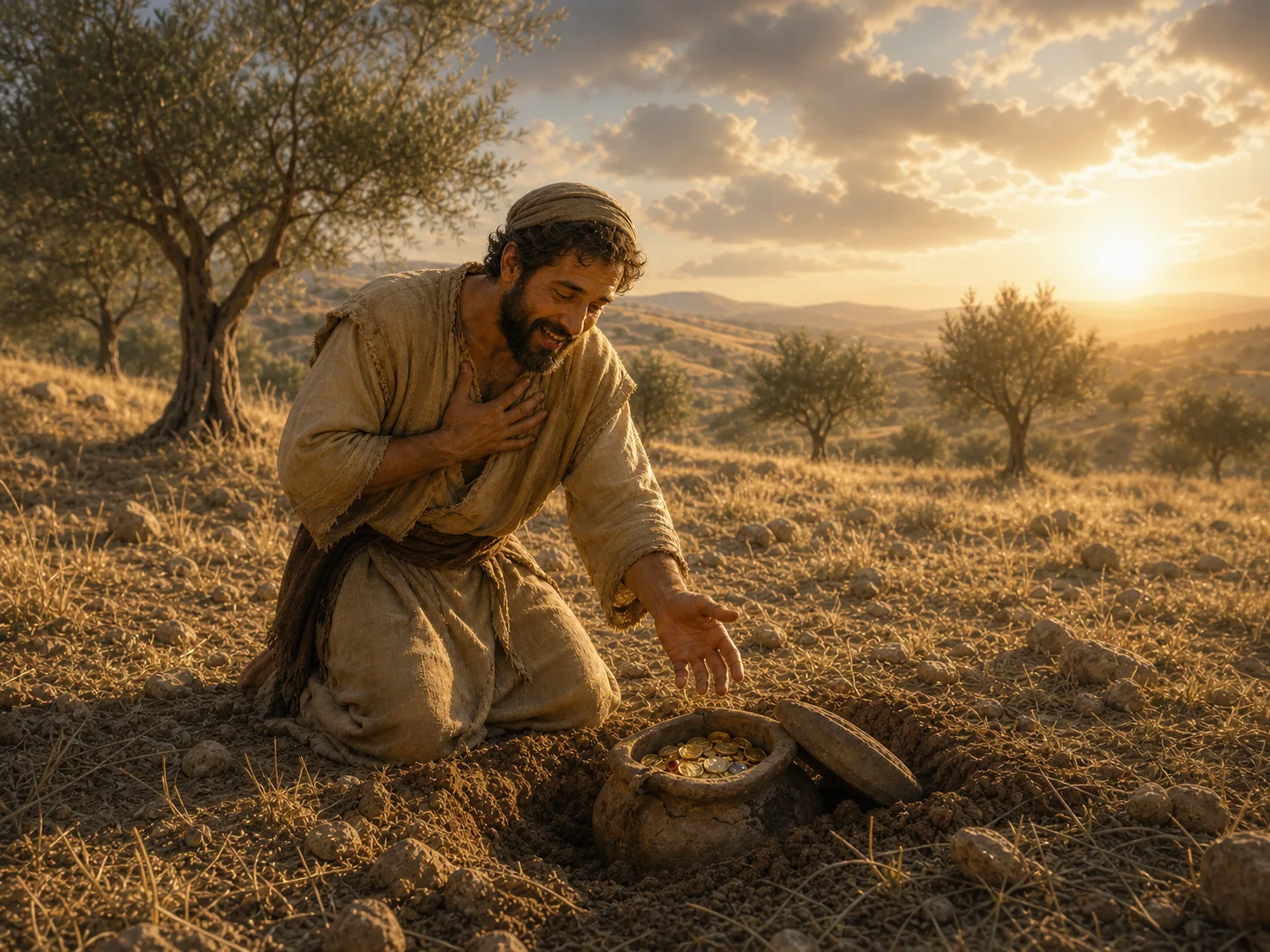
Two men find the same thing by two different routes. The first is not looking for anything. He is at his work in a field that belongs to somebody else, and his spade strikes something hard. In a country repeatedly overrun by armies, and with no banks to speak of, burying valuables in the ground was ordinary prudence, and treasure lost by one generation could lie undisturbed for another. The second man has spent his working life at exactly this search. He is a merchant in pearls, he knows the trade, and after long looking he finds the one pearl that is worth more than the whole stock he has assembled.
Both kinds of people are sitting in the church on Sunday. Some meet Christ without expecting to. Others have questioned, studied, prayed and argued for years, and then recognise in Christ the thing they were looking for the whole time. Grace is at work in both, and the response of both is identical. Each sells everything he has.
Notice that first the treasure is found; then the sacrifice follows, and it follows gladly. Take the joy away and every renunciation the Church has ever asked of us becomes unintelligible. The man is not impoverishing himself. He is making the best exchange of his life, and he knows it.
In the third parable the net is dragged through the sea and brings in fish of every kind, and the sorting is left until it is hauled ashore. Jesus does not finish by celebrating the size of the catch. He tells us plainly that at the end of time the wicked will be separated from the just, and he uses the language of the blazing furnace and of weeping and grinding of teeth. The same Lord who shows us the treasure warns us that it can be lost. While the net is still in the sea, the time of mercy remains.
How These Readings Fit Together
Solomon is young, newly king, and frightened by the size of the job. He does not ask God to change his circumstances. He asks God to change his heart: give your servant a heart to understand how to discern between good and evil. He has understood something that takes most of us much longer. The hardest thing in life is not getting what we want. It is recognising what is worth wanting in the first place. We can spend thirty years pursuing something and find at the end of it that it could never have satisfied us in the first place.
That is what wisdom is: seeing things as God sees them, so that the genuinely valuable can be told apart from what merely looks attractive. The psalm puts it in the plainest terms available. The law from God's mouth is worth more than silver and gold. And the two men in the parables display the wisdom Solomon asked for. When the treasure appears in front of them, they know what they are looking at, and they do not hesitate.
Finding the treasure does not exempt anyone from suffering. But God turns everything to the good of those who love him, and what God allows suffering to transform us into true images of his Son. This is not a promise that everything which happens to us is good. God did not create betrayal, cruelty, illness or sin, and we are not asked to accept them as though he had sent them. We resist evil, protect the vulnerable and do what good lies within our power. When we have done what we can, faith entrusts the remainder to the Father, who can use our wounds to make us compassionate and our failures to make us humble. Nothing put into his hands is wasted.
The Fathers on Sunday's Gospel
"The kingdom of heaven is worth as much as you possess."
St Gregory the Great (†604), Homily 5 on the Gospels, quoted by St Thomas Aquinas
Gregory preached those words on the call of the first disciples, and they are the shortest commentary anyone has written on this Sunday's parable. There is no fixed price on the Kingdom. Peter and Andrew paid nets and a boat, because that was what they had. Zacchaeus paid half his fortune. The widow paid two small coins and, as Our Lord pointed out, paid more than anybody else in the Temple that day. What is asked is not a sum but everything, and everything is a different quantity in every life.
So "selling everything" does not take the same outward form in every vocation. For some it means a literal leaving of possessions and a former way of life. For a husband or wife it means loving a spouse and children with a patience beyond what our nature is willing to give, and dying to self on an ordinary evening when nobody says thank you. At work it means the small dishonesties everybody permits themselves, and the ambition that treats other people as obstacles. For another it means the grudge fed carefully for ten years, or joining the queue for confession, or finally answering something God has been asking for a long time. The outward form differs. The claim of Christ is the same. He comes first, and everything else is loved and lived in obedience to him.
Gregory noticed one further detail, that the man in the parable hides the treasure again after finding it. Our zeal for heaven needs guarding, he says, and not only from the evil one. It needs guarding from our own appetite for being admired.
A Question for the Family Table
God said to Solomon: "Ask what you would like me to give you."
If God asked you that tonight, in your own house, what would you ask him for? And then the harder question, the one the parables are really putting to us: is there anything you are holding onto that would have to go, if you were serious about the answer you have just given?
Next Sunday
Next Sunday: 18th Sunday in Ordinary Time. "They all ate as much as they wanted" (Matthew 14:13–21).