

This Sunday's Readings
First Reading: Wisdom 12:13, 16–19. "In the place of sin, you give repentance."
Responsorial Psalm: Psalm 85(86). ℟ O Lord, you are good and forgiving.
Second Reading: Romans 8:26–27. "The Spirit himself expresses our plea in a way that could never be put into words."
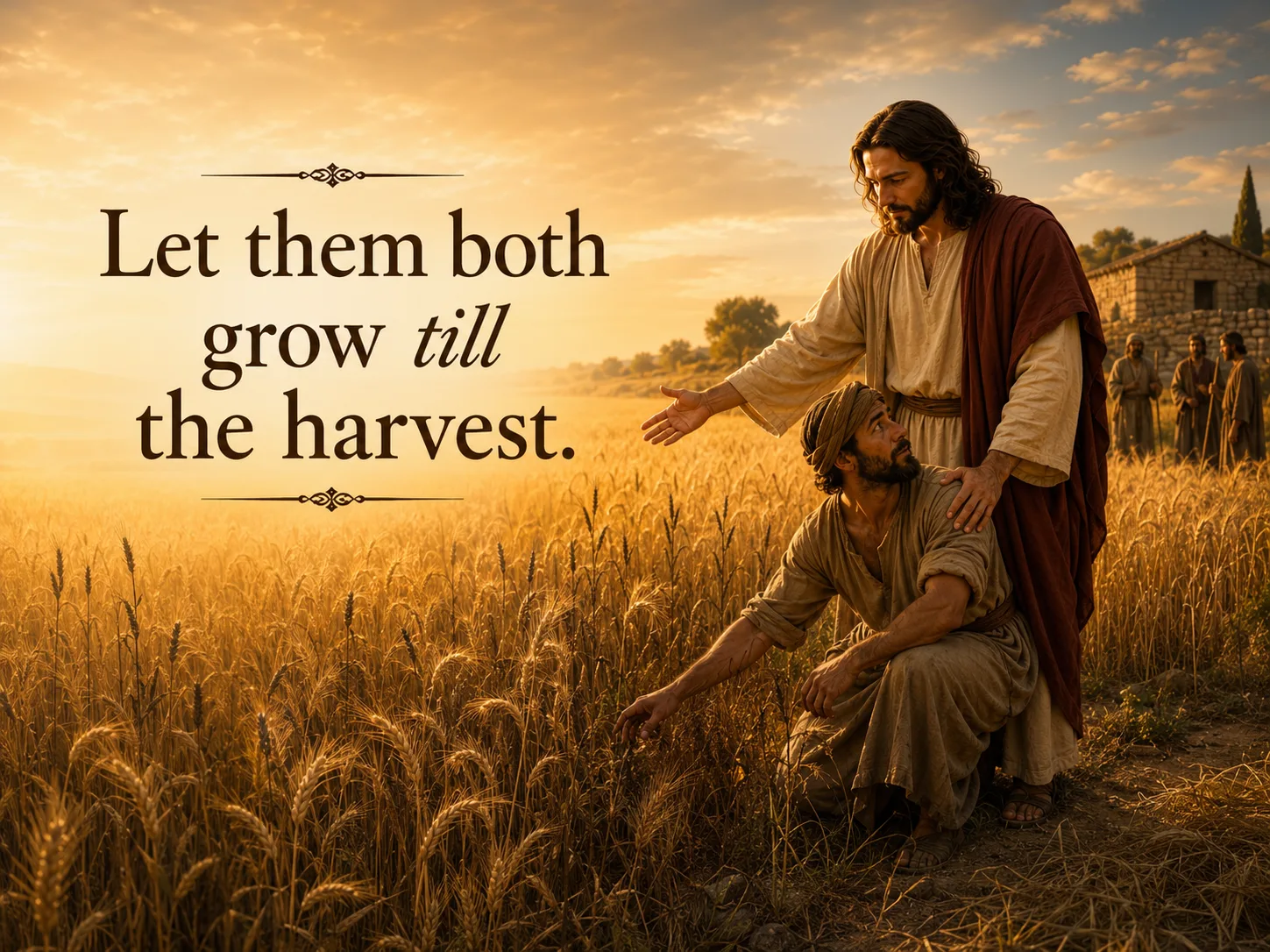
Gospel: Matthew 13:24–43. "Let them both grow till the harvest."
This Week's Gospel
We continue in the thirteenth chapter of Matthew's Gospel, and again Jesus gives us a riddle to solve. Last week the twist was a sower who scattered good seed everywhere, even on hopeless ground. This week the twist is a farmer who refuses to weed.
An enemy has sown darnel among the wheat. Darnel is a poisonous rye-grass which, in its early growth, is almost impossible to tell apart from wheat; only when the ear forms does the difference show, and by then the roots of the two plants are tangled together underground. The servants want to act at once and pull the weeds up. Any farmer would sympathise. But the master forbids it: in uprooting the darnel they would uproot the wheat as well. Let them both grow till the harvest.
Here is the riddle we all feel: why does God not simply pull up the weeds now? Why must we put up with so much evil in the world, and even in the Church? The parable gives two answers. The first concerns us. Wheat and darnel look alike, and so do souls; if judgement fell today, are we certain which we would be? Are we constantly in a state of grace, tirelessly serving God and neighbour, saints already? The unsettling truth is that sometimes we are the weeds Jesus is patiently hoping to transform into wheat. God delays the harvest not because he is indifferent to evil but because he is merciful to us: he leaves room for repentance, and unlike darnel in a field, a soul can change its nature.
The second answer concerns the end. The delay is not a cancellation. Jesus is clear and unambiguous: there will be a harvest, the weeds will be gathered and burned, the wheat gathered into the barn, and the virtuous will shine like the sun in the kingdom of their Father. Hell is not presented as a theoretical possibility. Our choices matter, and time is not unlimited. The patience of God is an invitation, not a reprieve without end.
The two short parables that follow, the mustard seed and the leaven, answer a related discouragement. The Kingdom in this world looks small, hidden, unimpressive, a mixed field rather than a pure one. Yet from the smallest of seeds comes a tree where the birds shelter, and a little leaven works silently until the whole batch is transformed.
How These Readings Fit Together
The first reading, from the Book of Wisdom, is the theology behind the farmer's patience. God's lenience does not come from weakness but from strength: his sovereignty over all makes him lenient to all, and he governs with mildness precisely because his power is total. By acting like this, Wisdom says, he has taught his people a lesson: the virtuous man must be kindly to his fellow men, and after sin God gives repentance. The psalm turns that lesson into prayer: "O Lord, you are good and forgiving, full of love to all who call."
The second reading continues our journey through Romans 8. In the long waiting between sowing and harvest, we do not wait alone: the Spirit comes to help us in our weakness, interceding for us in a way that could never be put into words. When the evil in the world, or in our own hearts, tempts us to discouragement, our task is not to seize the sickle but to pray, trusting the Spirit who pleads for the saints according to the mind of God.
The Fathers on Sunday's Gospel
"Room for repentance is left, and we are warned that we should not hastily cut off a brother, since one who is today corrupted with an erroneous dogma may grow wiser tomorrow, and begin to defend the truth."
St Jerome (†420), Commentary on Matthew, on this Sunday's parable
Jerome, who knew the fields of the Holy Land, notes that between wheat and darnel there is a great likeness, and that so long as the plant is only in blade no one can tell one from the other. This, he says, is why the Lord counsels patience: we must not pass sentence where the matter is still doubtful, but leave judgement to the one Judge who cannot mistake the crop. The history of the Church proves him right. Persecutors have become apostles, heretics have become doctors, and public sinners have become saints. Had the servants been given their way, the field would be tidier and heaven emptier. He sows everywhere because he hopes for everyone, and he waits because he hopes still.
A Question for the Family Table
Jesus said the field is the world, and that wheat and weeds must grow side by side until the harvest.
Is there someone whose faults test your patience at home, at school or at work? St Josemaría Escrivá advised: don't say, "That person gets on my nerves"; think, "That person sanctifies me." What would change this week if you saw that person not as a weed to be pulled up, but as someone God is patiently waiting for, and as a means God is using to make you holy?
Next Sunday
Next Sunday: 17th Sunday in Ordinary Time. "He sells everything he owns and buys the field" (Matthew 13:44–52).