

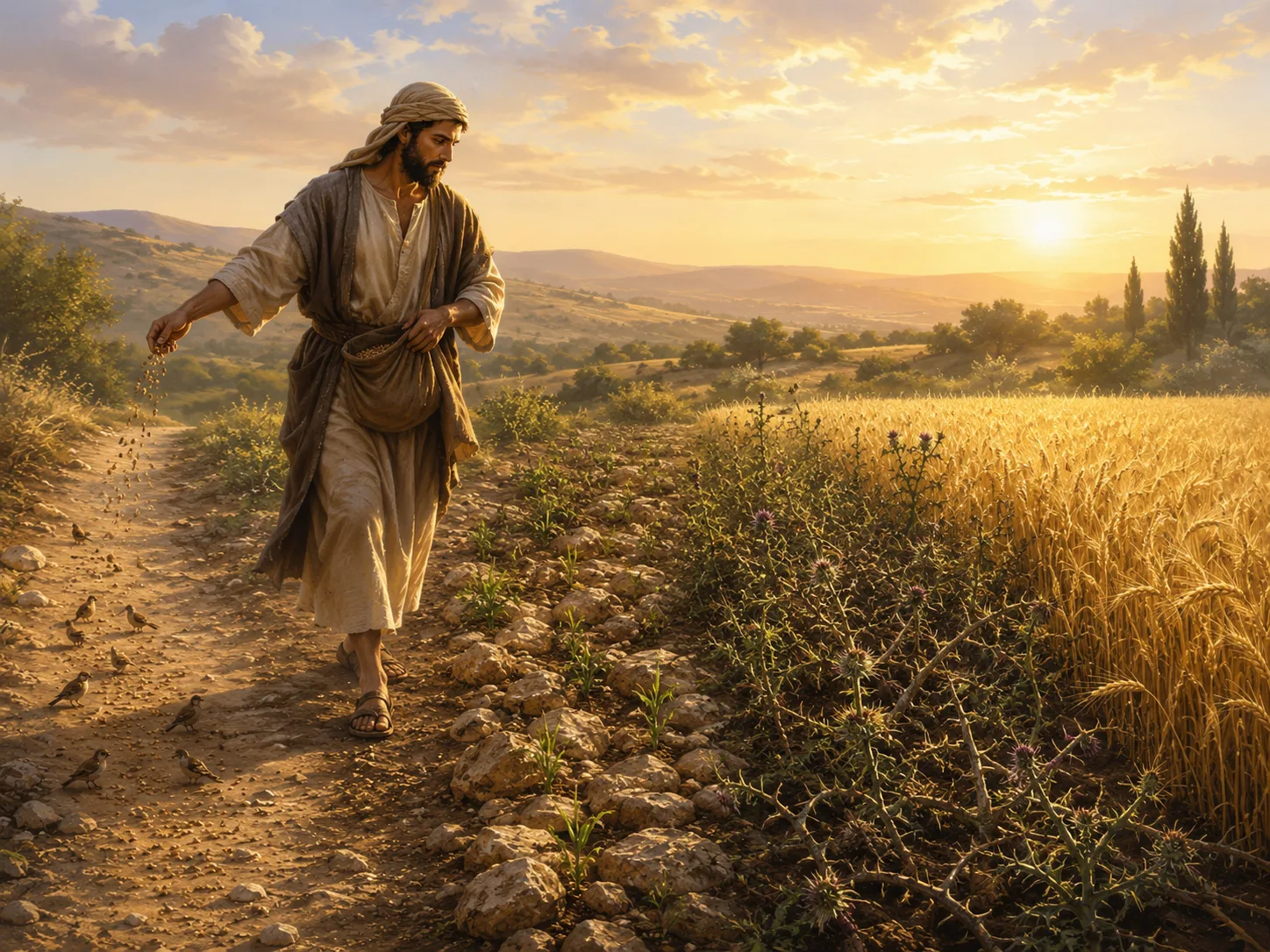
Some Seed Fell on Rich Soil
This Sunday's Readings
First Reading: Isaiah 55:10–11. "The rain makes the earth give growth."
Responsorial Psalm: Psalm 64(65). ℟ Some seed fell into rich soil, and produced its crop.
Second Reading: Romans 8:18–23. "All creation is waiting for the revelation of the children of God."
Gospel: Matthew 13:1–23. "A sower went out to sow."
This Week's Gospel
This Sunday we begin three weeks in the thirteenth chapter of Matthew's Gospel, which contains some of Jesus' best-known parables. A parable is more than a story comparing one thing to another; it is a kind of riddle, and the way into a riddle is to look for the twist, the detail that doesn't fit.
In the Parable of the Sower the twist comes at once: the sower scatters seed on the path, on rocky ground, among thorns. For a first-century farmer this simply wasn't done. Seed was expensive; you sowed it carefully, only where it stood a chance. This sower looks careless, even wasteful. And the harvest he reaps is stranger still: an average crop in Galilee yielded perhaps seven or eight times what was sown, and a very good one ten. Jesus speaks of a hundredfold, sixty, thirty: a miraculous, super-abundant crop.
Then Jesus gives his disciples the key to the riddle. The seed is the word of the Kingdom, which means the sower is Jesus himself. The "carelessness" is in fact boundless generosity: he brings the word to everyone, to those who will receive it and to those who will not, because God wants all to be saved. What varies is not the seed but the soil. The path, the rock and the thorns are the hearts that hear the word: the heart it never penetrates, the heart that receives it eagerly but abandons it when discipleship proves costly, the heart in which worry and the desire for wealth choke it. The good soil, Jesus says, is those who hear the word and understand it, who receive it not only with the heart but with the mind, pondering it, studying it, letting it take root. In them the seed bears its impossible harvest.
How These Readings Fit Together
The first reading is God's own guarantee of the parable. Through Isaiah he promises that his word, like the rain and snow, does not return to him empty: it succeeds in what it was sent to do. If the word fails to bear fruit in us, the fault is never in the seed. The psalm places the parable on our lips as praise: God has visited the earth, watered it, and blessed its growth. "Some seed fell into rich soil, and produced its crop."
The second reading widens the lens from the field to the whole of creation. Paul says that creation itself groans "in one great act of giving birth," waiting with eager longing for the harvest to come: the revelation of the children of God and the redemption of our bodies. The sufferings of the present time are the tilled and broken ground; the glory to be revealed is the hundredfold crop.
The Fathers on Sunday's Gospel
"As the sower makes no distinction in the land, but simply and indifferently casts his seed, so the Lord makes no distinction of rich and poor, of wise and foolish, but speaks to all."
St John Chrysostom (†407), preaching on this very passage (Homily 44 on Matthew)
Chrysostom faces the obvious objection: why would any sensible farmer waste seed on rock and thorn? His answer is that in the field of souls, the soil can change. Rock cannot become earth, but a hard heart can become a soft one; the wayside can be ploughed, the thorns uprooted. Had the sower judged by appearances and sown only in "promising" ground, many of the greatest saints, once persecutors, tax collectors and thieves, would never have heard the word at all. He sows everywhere because he hopes for everyone.
A Question for the Family Table
Jesus said the seed is the word of God, and our hearts are the soil.
What kind of soil has your heart been this week? Is there a "bird, rock or thorn" in your life, a distraction, a difficulty, a worry, that keeps God's word from taking root in you? What is one thing you could do this week to become richer soil?
Next Sunday
Next Sunday: 16th Sunday in Ordinary Time. "Let them both grow till the harvest" (Matthew 13:24–43).