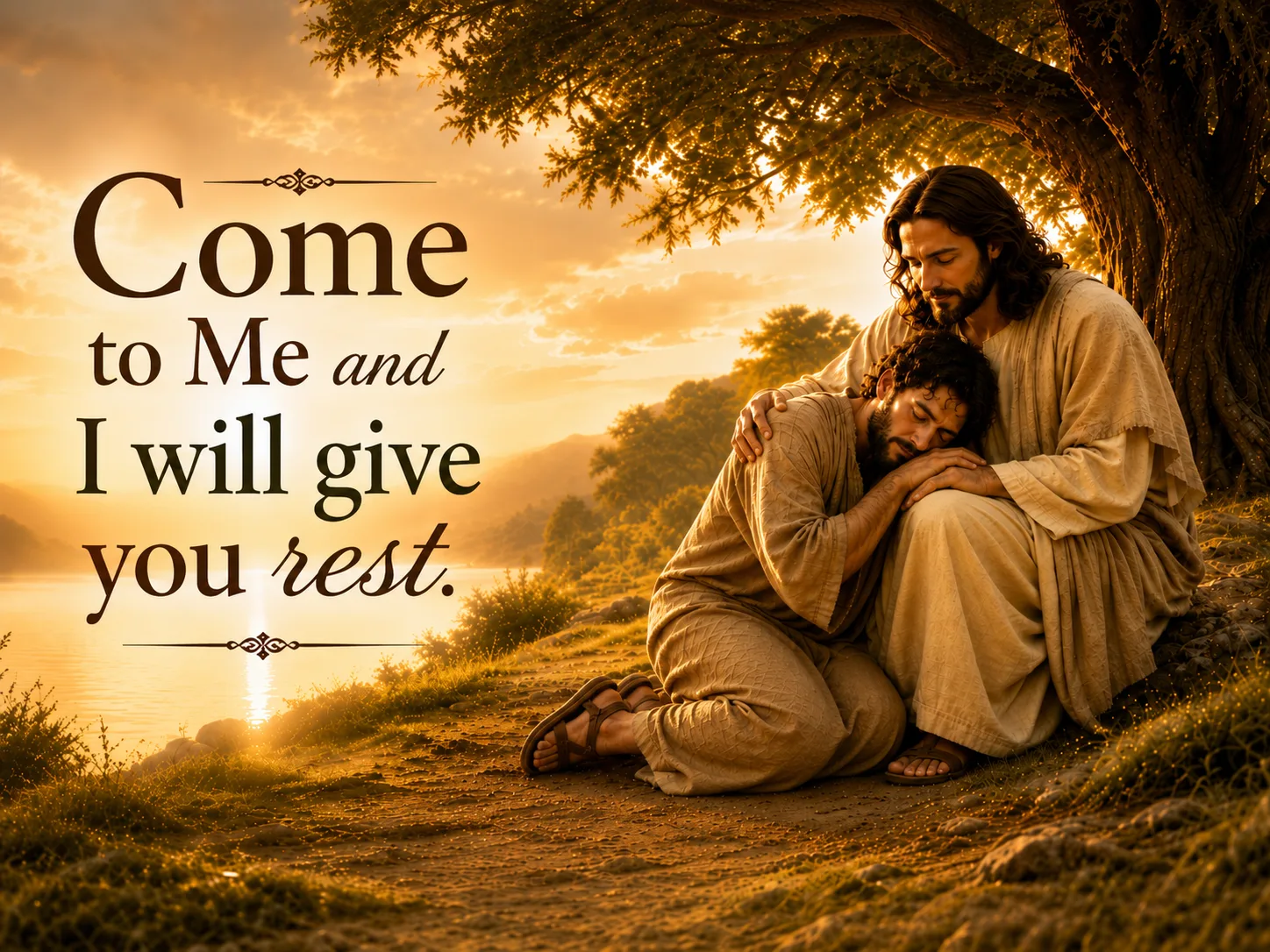
"Come to me, all you who labour and are overburdened..."
Preparing for Sunday: 14th Sunday in Ordinary Time (Year A)
This Sunday's Readings
First Reading: Zechariah 9:9–10. "See how humbly your king comes to you."
Responsorial Psalm: Psalm 144(145). ℟ I will bless your name for ever, O God my King.
Second Reading: Romans 8:9, 11–13. "If by the Spirit you put an end to the misdeeds of the body you will live."
Gospel: Matthew 11:25–30. "I am gentle and humble in heart."
This Week's Gospel
This Gospel opens at a low point in the ministry of Jesus. The towns that saw his greatest miracles — Chorazin, Bethsaida, Capernaum — have refused to repent. And at that very moment, Jesus lifts his eyes and blesses his Father. What looks like failure becomes an act of praise, because Jesus sees what the Father is doing beneath it: hiding these things from the wise and learned, and revealing them to little children.
The "wise and learned" had studied the Law all their lives, but their learning had made them full. A child in the ancient world owned nothing and depended on its parents for everything — food, protection, life itself. Everything was received as a gift. That is the posture in which revelation can be received, because revelation is a gift; it cannot be earned or worked out.
Then comes one of the most staggering sentences in the Gospels: "No one knows the Son except the Father, and no one knows the Father except the Son." Here, in the middle of Matthew, Jesus speaks as only the eternal Son can speak. Who God is can be known only because the Son has chosen to show us — and he shows himself to fishermen, tax collectors, and ordinary people who knew their need.
To these he says: "Come to me, all you who labour and are overburdened, and I will give you rest." And in the same breath: "Shoulder my yoke." A yoke is made for two. Christ does not stand at the edge of the field giving orders; he steps into the harness and pulls alongside us.
How These Readings Fit Together
The prophet Zechariah foresees a king unlike any the world had known: victorious, yet riding not a warhorse but a donkey; a king who banishes the chariot and the bow and proclaims peace to the nations. Israel waited centuries to see him. In this Sunday's Gospel he identifies himself: "I am gentle and humble in heart." The humble king has come, and his kingship is exercised not by laying burdens on his people but by lifting them. The psalm gives us our response: "I will bless your name for ever, O God my King."
The second reading tells us how his yoke can possibly be easy. Paul says that the Spirit of God has made his home in us. Christ does not merely walk beside us giving direction from outside; by his Spirit he works within us, putting to death the misdeeds of the body and giving life to our mortal bodies. The unspiritual life — slavery to the flesh — is the truly exhausting yoke. The life of the Spirit is the rest the Gospel promises, begun now and completed in the resurrection.
The Fathers on Sunday's Gospel
"The things which are hard for those who labour lose their roughness when they love."
St Augustine (†430), preaching on this very passage (Sermon 70, on Matthew 11:28)
Augustine faces the obvious objection: how can Christ's yoke be called easy when Christians suffer so much? His answer is that love changes the weight of things. A mother does not calculate the cost of a sleepless night with a sick child; love makes the hard thing bearable, even sweet. The yoke of Christ is light not because it asks little, but because it is carried in love — and carried with him.
A Question for the Family Table
Jesus said, "Come to me, all you who labour and are overburdened, and I will give you rest."
What feels heavy for you at the moment — a worry, a job, something at school? Have you told Jesus about it and asked him to carry it with you?
Next Sunday
Next Sunday: 15th Sunday in Ordinary Time.
"Imagine a sower going out to sow" (Matthew 13:1–23).