

Preparing for Sunday: 13th Sunday in Ordinary Time (Year A)
This Sunday's Readings
First Reading: 2 Kings 4:8–11, 13–16. "This is a holy man of God; let him rest here."
Responsorial Psalm: Psalm 88(89). ℟ I will sing for ever of your love, O Lord.
Second Reading: Romans 6:3–4, 8–11. "When we were baptised we went into the tomb with Christ, so that we too might live a new life."
Gospel: Matthew 10:37–42. "Anyone who loses his life for my sake will find it."
This Week's Gospel
These are the closing words of Jesus' instruction to the Twelve before he sends them out, the end of the great missionary discourse that runs through the whole of Matthew chapter 10. He has told them what their mission will cost. Now he tells them what it asks of the heart: that he himself come first, before father and mother, before son and daughter, before life itself.
Sit with how extraordinary that demand is. No prophet, no teacher, no holy man of the Old Testament ever spoke like this. Only God may rightly ask to be loved more than a person's own father and mother, for God is the source of those loves in the first place. In a single sentence Jesus quietly claims what belongs to God alone. The natural affections are good and holy, yet they are not the highest thing, and when they compete with Christ they must yield.
Then comes the first mention of the cross in Matthew's Gospel. The Lord names it here as the mark of a disciple, before he has said a word about his own Passion. The cross is set before us as the shape of a Christian life long before it is revealed as the instrument of our redemption. And with it comes the paradox at the very centre of the Gospel: the one who clings to his life loses it, and the one who lets it go for Christ's sake finds it whole.
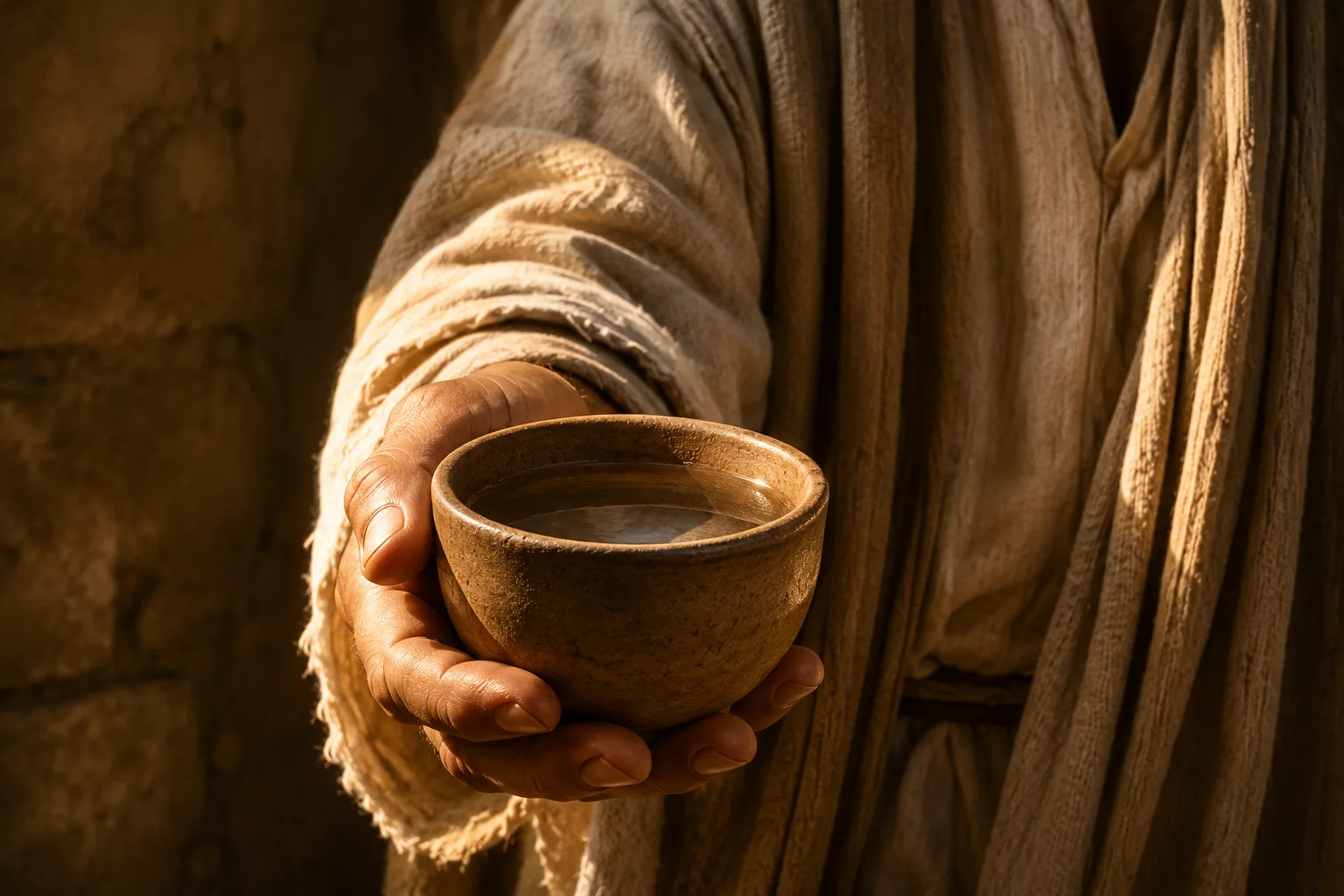
The second half of the reading turns to those who receive the disciples. Here Jesus binds himself to his messengers with astonishing closeness: to welcome them is to welcome him, and to welcome him is to welcome the Father who sent him. The smallest kindness shown to one of his own, even a cup of cold water, is shown to Christ and will not go unrewarded. This is the ground of all Christian hospitality, and the reason the Church has always seen the face of Christ in the stranger, the poor and the little ones.
How These Readings Fit Together
The Gospel promises that "anyone who welcomes a holy man will have a holy man's reward." The first reading shows that promise kept. A woman of Shunem welcomes Elisha, "a holy man of God," asking nothing in return: she builds him a room, furnishes it with a bed, a table, a chair and a lamp. And her reward is the gift she had given up hoping for. "This time next year you will hold a son in your arms." She welcomes a prophet, and she is given life.
The Gospel's hardest line, "anyone who loses his life for my sake will find it," can sound bleak on its own, as though Christ were asking us to throw our lives away. But in the second reading Paul helps us to understand Jesus' words in the light of our baptism. When Christ tells us to lose our life for his sake, he is not asking for something we have yet to face. In baptism it has already happened. We have died with Christ, and in a sense we are dead to the world: we live now for him, whose rising we will one day share. So losing our life for Christ is not a step into the dark. It is living out what we already are — no longer our own, but his — in the sure hope of the resurrection he has promised us.
The Fathers on Sunday's Gospel
"He did not ask for warm water, which a poor man might lack the means to heat, but cold, which costs nothing and is within everyone's reach, so that no one, however poor, should have any excuse for failing in love."
St John Chrysostom (†407), on the cup of cold water (Homilies on Matthew, 35)
Chrysostom catches something easily missed. Christ deliberately sets the bar of charity at its lowest, a cup of cold water, so that no one can ever say they had nothing to give. The reward is promised not for the size of the gift but for the love in it. This week, look for the small kindness you are tempted to think too small to matter.
A Question for the Family Table
Jesus said that even a cup of cold water given to someone because they belong to him will never be forgotten by God.
What small kindness could you do for someone this week, the kind nobody would even notice?
Next Sunday
Next Sunday: 14th Sunday in Ordinary Time.
"Come to me, all you who labour and are overburdened, and I will give you rest" (Matthew 11:25–30).